In the past twenty years, Agile has established itself as the pinnacle of project management. So, it’s easy for organizations to see the benefit of moving away from traditional approaches like Waterfall. The only problem: teams falling short of a full transition can accidentally blend Waterfall and Agile into Wagile.
Some teams argue that Waterfall offers pros Agile can’t. While Waterfall brings advantages to the table, disguising it behind a halfhearted Agile transition offers the worst of both worlds.
Below, we’ll explain each approach to help you make the right choice between Agile vs. Waterfall.
Table of contents:
Waterfall development is a straightforward approach to project management. It’s a sequential methodology where projects follow a specific order of phases. Teams map out these stages and their goals before diving in. As a result, projects move along one step at a time. So if you want to revisit an older phase, you may have to start over.
Waterfall is over a half-century old and has inspired many other methods. In fact, the software development lifecycle draws from Waterfall’s structure:
Waterfall offers a few distinct advantages, including:
Unfortunately, Waterfall has earned a less-than-stellar reputation in recent years. It may fail on large projects with changing requirements, which is an increasing norm.
As a result, there’s a tendency to push all requested or possible changes into “phase two,” extending the project. On the other hand, devs may frontload requirements and lose control over the project’s scope. Some of these issues stem from Waterfall’s:
Waterfall suits projects with clear goals built on existing software. Consider taking the approach when porting an existing product to a new platform. For example, Waterfall teams can port board games to a mobile app. With that in mind, Waterfall works best with predetermined timelines and constraints devs understand upfront.
You'll want to avoid the Waterfall method on any projects facing changing requirements. It also isn't suited to updating products like websites or mobile phone apps. Its infrequent releases cause user frustration and allow competitors to reach customers first.
Waterfall project management offers more consistency and control than Agile. Instead of juggling multiple teams and tracking changes, it presents a straightforward approach. As a result, Waterfall suits:
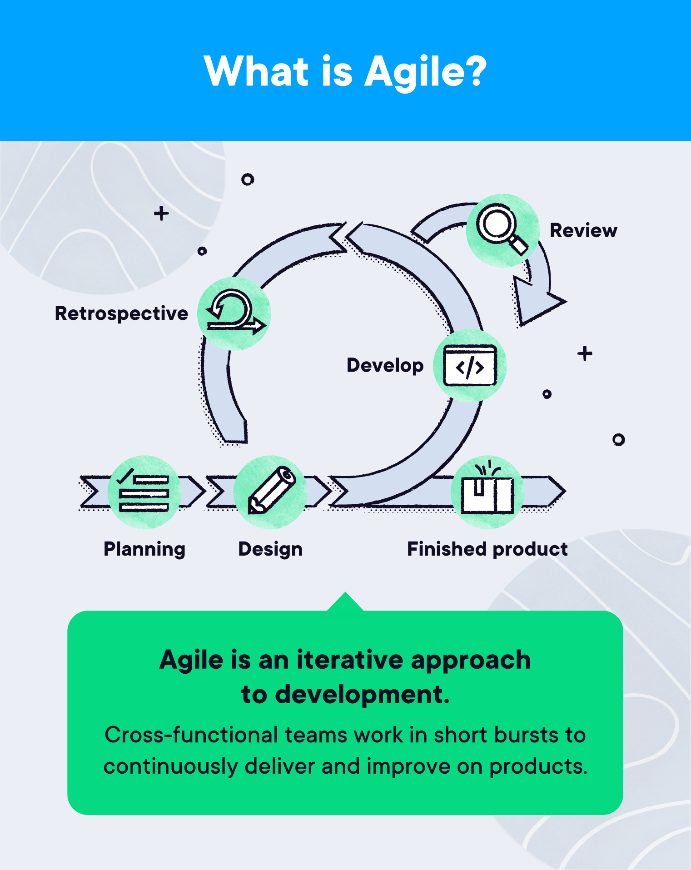
Two decades back, Agile was born in response to Waterfall's limitations. Specifically, devs wanted a more flexible approach with frequent deliveries. Whereas Waterfall sets clear goals upfront, Agile gives room to adapt and change as you go. It also gives more space for stakeholder involvement.
Agile projects don’t move in a linear sequence of stages. Different teams work on their own aspects of a project at the same time. They also use more short-term dev cycles called sprints to accommodate changes in direction. This iteration works to boost productivity but requires:
The main benefits of Agile include:
While Agile is great for innovative work, that can mean projects have no predetermined ending. This can make the project last longer than expected. That lingering status tarnishes its reputation in some circles. While some teams love the iterative approach, Agile struggles with:
You should consider Agile project management when facing projects with stakeholder involvement or changing requirements. Its continuous delivery model also suits DevOps or SecDevOps teams with incremental releases.
Finally, consider Agile when you’re developing anything with a social media feature, since user feedback is critical to the direction of the product. Ignoring this feedback can backfire quickly.
Agile won’t always meet your needs, especially when government regulations dictate your scope and timeline. This often occurs in regulated fields like the healthcare industry. The “move fast and break things” method just doesn’t play as well in regulated fields.
Compared to the Waterfall method, Agile affords a more fluid take on development. Teams can adjust to changing requirements, work in parallel, and collaborate with stakeholders. As a result, Agile is good for:
Now that we’ve broken down both approaches, we can compare Agile and Waterfall directly. Here are the main differences between Waterfall and Agile to keep in mind:
Agile and Waterfall build products with different approaches:
Your dev timelines will vary depending on your method. Agile bases projects on short, one-to-four-week sprints. Sprint planning occurs on the front end of a project and preps devs before they jump in. This approach offers flexibility and extensions for continuous improvement. By contrast, Waterfall operates within a defined start and end date.
Each approach comes with requirements needed for development:
Over a project lifecycle, Agile budgets are subject to change. As new product requirements and feedback arrive, devs can increase their budget to accommodate the change. On the other hand, Waterfall development sets a budget before each project, so devs must ensure they have the resources they need upfront.
While Agile and Waterfall both accept client participation, they work through unique avenues:
Agile tends to offer more flexibility than Waterfall because Agile incorporates flexibility into its core structure. Sprints allow for adaptation and change across a project lifecycle. Waterfall involves rigorous planning and moving through predetermined steps on each project.
Depending on your organization structure, one approach may work better than the other. In general, Agile suits:
On the other hand, Waterfall works better for:
Agile and Waterfall represent broad development approaches. As a result, teams can hone their core principles into specific frameworks. Depending on your team size and goals, certain Agile or Waterfall frameworks may suit you better.
Agile frameworks include:
Here are some popular Waterfall frameworks:
Some teams combine Waterfall and Agile to create a hybrid commonly known as Agilefall, scrum-fall, FRagile, and—our favorite—Wagile. In other cases, teams stumble into it when transitioning from Waterfall to Agile. While it can sound like a great match on paper, Wagile is built on incompatible parts.
Many leaders and teams create their Wagile process with the intent to capitalize on:
Wagile may promise all of this and more, but it can’t deliver. In fact, Wagile can be detrimental to your goals. It offers:
We’ll cut straight to the chase: There are no pros to Wagile. The approach promises devs a perfect method Wagile can’t provide. Fundamentally, Agile and Waterfall aren’t compatible enough to form a hybrid process. Seriously, Wagile is the worst.
Always, or when you want to succeed. Instead, commit to one methodology and leverage its strengths. That will help your organization more than Wagile ever could.
That said, you might stumble into Wagile by accident. You could find yourself using it at the beginning of a transition from Waterfall to Agile. During this switch, people may say Agile isn't working. But when you're in a Wagile state, you're not in Agile. Agile will work just fine once you can get there.